

Of Creativity and Subjectivity

What is creativity? Ask a hundred people and you’ll probably get a hundred answers. Or at least ten and some deviations.
For me, creativity is that ability to take an input and produce an output which ends up bringing value to at least one person. And usually, that “at least” one person is the actual individual who exercises the creativity. In my case, me. Because if you can’t bring value to yourself by being creative, you surely don’t have any chance of bringing value to a second party or more.
After it brings value to you, the one person, creativity can move on and bring value to other people, if you let it.
However, that’s where subjectivity comes in the picture. Your creativity, or my creativity, or anybody else’s creativity will only bring value to the people that see value in it. And seeing value in it is a matter of subjectivity.
Subjectivity is the quality of being based on or influenced by personal feelings, tastes, or opinions. It’s the notion that implies a personal perspective, which can be defined by all of the above and sometimes even more - like context, circumstance, moment in time, and so on.
Let’s take a few practical examples of subjectivity that applies to different forms of creativity, to clarify how it works.
The Movie/Show
Take the show Countdown. I started watching it because of Jensen Ackles. I like him ever since Supernatural and whenever he’s involved in a new project, I learn everything I can about it to see if it’s something I would enjoy watching.
Countdown sounded like an interesting show so I got into it. I was hooked from the first episode, seeing how I love action movies and the writing and characters were all very compelling from the start.
But what got my attention the most was the unusual structure of the show. Most follow typical patterns. Story arcs that end when the season ends, or sometimes let you go with a cliffhanger meant to be resolved when the next season begins.
Countdown did both and neither. It had 13 episodes, and the first story arc ended in episode 10. I was a bit shocked the show did not end there, but I loved that it had more episodes and it didn’t stick to the pre-established patterns of TV writing, that nowadays feel like a dogma everybody in the industry adheres to.
The next three episodes consisted of a different story arc, that ended on a cliffhanger. Which was both sweet and sour, because while being original, it also leaves you hanging.
We must agree though that it was thought outside the box. And that, to me, felt like a breath of fresh air. This became even more fascinating when I realized the entire show was written by one person: its creator, Derek Haas.
And all that fell right in my head when I discovered this review while searching for information about a potential renewal. This was completely unexpected and shows the exact idea of this article.
Subjectivity. The reviewer in question thought the show was a mess, for various reasons.
The romance between Meachum and Oliveras. I’m not one for romance in movies, as I usually go for the action flick or the Science Fiction and High Fantasy works, but I recognize good writing when I see it. And the romance between Meachum and Oliveras added an entire narrative thread to the story, with interesting implications that will (or would) surely propagate within Season 2 as well, based on the Season 1 cliffhanger (if there will ever be a Season 2).
The exact original structure I praised it for (The three extra episodes). This is peak subjectivity, as it’s obviously a matter of preference. I loved it because it was creative and original, he hated it because it didn’t follow pre-established patterns. It’s a question of what kind of viewer you are, but it just goes to show how different we are in our perceptions and how one’s hard work can mean the world to someone, and zilch to someone else.
The cast. He didn’t feel like the viewer connected with the cast. I have mixed feelings about this, as I connected with certain characters (because you connect with the characters, not the cast - I connected with Meachum, not with Jensen Ackles, am I right?), but didn’t connect with others. Come to think of it, that is normal. It’s what happens in life as well. You connect with some people better than with others, and I think it would have been really strange to feel the same degree of connection with all the characters. It would have meant either the writing was bad or all the characters would have had really complex backstories and dedicated plots, which can’t possibly be done in thirteen episodes, no matter how good you write, as dedicating too much story to specific characters would distract the viewer from the main story, therefore balance is key.
The Book
The last book I’ve read, “Howl’s Moving Castle”, by Diana Wynne Jones, has 4.29 out of 5 on Goodreads.
I… did not enjoy it that much.
Don’t get me wrong: The story is fascinating, the characters are really funny and relatable, and the world building is insanely creative. But there’s one thing that rubbed me off the wrong way, as I write in my review as well: overwhelming descriptions. Below a direct quote.
I have a pet peeve with books, and my pet peeve is descriptions. In my humble opinion, descriptions should be minimal. They should just set the framework for the rest of the story and leave the rest to the imagination of the reader.

In “Howl’s Moving Castle”, possibly in an attempt to animate the world in which the story takes place, the author often exaggerates when describing things. I kid you not, at some point she was describing the food on a table, and was basically listing dishes, meats, vegetables and fruits, like a thesaurus. For an entire paragraph.

This style of description distracts the reader from the story, and I often had to take a break and found it really hard to pick up the book again and continue reading.
This is, obviously, my subjective opinion. If you read through the plethora of reviews on Goodreads, everybody loved it! Me, on the other hand, gave it three stars because after seeing the overwhelmingly positive reviews, I feared I was too harsh to give it two (my original intended rating).
I know that losing three stars for descriptions sounds excessive, but remember that for me it was a deal-breaker. I often found myself putting it down and not being able to get back at it again. So I considered this a real issue with the writing.
The Gaming Magazine Cover
This is an interesting one. It’s about a Romanian gaming magazine called Grind. They release issues once every few months, and they review video games and anything related.
But what they do that’s unique compared to other review magazines is that they release each issue in multiple covers.
Grind V, for example, had five covers. There were supposed to be six initially, but they ditched the Oblivion one, which was my favorite.
Now, bear with me as I get to the subjective part: Obviously, different people would have different preferences on which cover is the best. Right?
Below is a poll showing the user preference. You can also see the five covers that made the cut.
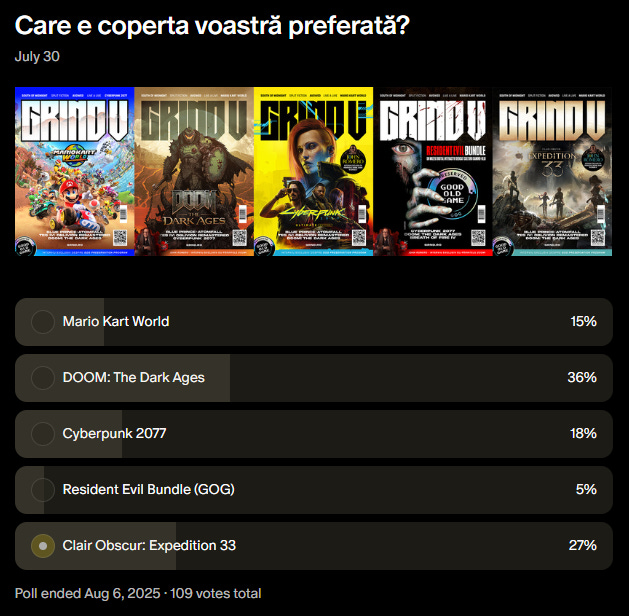
As you can see, the top choice was the Doom cover, with 36% votes. My preferred choice, as per the visible selection, was the Clair Obscur: Expedition 33 cover (for the lack of the Oblivion one), my second being the Resident Evil GOG cover.
My choice also follows a logic: Expedition 33 is a new game, a new Intellectual Property, and reflects the current era more than the rest. Also, the cover design is much more symmetrical than the rest (bar maybe the Mario Kart one) and it really looks like a premium magazine cover. The other covers are either pre-established IPs or retro games. Which isn’t bad in the slightest, obviously, but I felt my choice reflected better the magazine’s contents and the year it was released in (2025) rather than the rest.
You will say: But Indru, your other favorite cover was the canceled one featuring The Elder Scrolls IV: Oblivion Remastered, a remaster of a game in a pre-established IP.
And I will say: Yes. And that was the nostalgia factor. They are both subjective choices, one based on feelings (Oblivion) and one based on logic (Expedition 33).
Fun exercise: Which cover do you think I like the least?
Well, yes. It’s the Doom cover. For subjective reasons, of course: Even though I’m a longtime fan of the original Doom games, I dislike the new reboot series. It’s a personal preference (or lack thereof), not something inherently wrong with the games.
Conclusions
When creativity meets subjectivity is where the bubble breaks. It’s where reality, or the lack of it, hits the creator.
You will always encounter people that your work (sometimes all of it, sometimes parts of it) doesn’t resonate with (reality, like the cover example or the book example above, where you will meet constructive criticism), and people that don’t understand your work (the lack of it, like the TV show example above, where you will meet passive-aggressiveness). And that, I think, is normal.
It’s fascinating to a degree, because you sometimes wonder: How can someone else see it so differently than I do when it’s obvious that my perception is the correct one?
They can, because your perception is the correct one for you. Their perception is the correct one for them. And that, again, is normal.
Don’t be afraid of having different opinions or ideas, and don’t be annoyed at people who think differently than you. Find common ground if you can, or distance yourself if you can’t.
Communication is key.
Indru